

Key Takeaways
- GLP-1 medications help counter menopause-related weight gain by reducing appetite, improving insulin sensitivity, and targeting visceral abdominal fat that commonly increases during this stage of life.
- Among available options, Tirzepatide generally delivers the greatest weight loss due to its dual GIP/GLP-1 action, while semaglutide remains a highly effective, well-studied alternative with strong long-term data.
- Liraglutide is less effective and requires daily injections, making it a secondary option, mainly when newer GLP-1 medications are unsuitable or not covered.
- The most effective GLP-1 varies by individual factors, such as weight-loss goals, medical history, cost, and tolerance for side effects, with results developing gradually over several months under medical supervision.
- OrderlyMeds provides personalized GLP-1 treatment with both compounded semaglutide and Tirzepatide options, along with comprehensive support designed to help menopausal women achieve lasting results.
How GLP-1 Medications Help During Menopause
Menopause naturally slows your metabolism and increases abdominal visceral fat, making weight gain more likely and raising risks like insulin resistance and cardiovascular disease.
GLP-1 medications work by mimicking glucagon-like peptide-1, a hormone your gut naturally produces after eating. These medications signal your brain that you’re full, slow digestion, and improve insulin sensitivity, reducing hunger and promoting better blood sugar control.
For menopausal women, GLP-1 medications address multiple challenges: they counteract increased appetite associated with declining estrogen levels, improve insulin sensitivity, which often worsens during this transition, and help reduce visceral fat that accumulates around the abdomen.
Research confirms that GLP-1 medications work equally well across all reproductive stages, with studies showing significant weight loss regardless of whether women are premenopausal, perimenopausal, or postmenopausal.

OrderlyMeds: Medically-Supervised GLP-1 Weight Loss Made Accessible
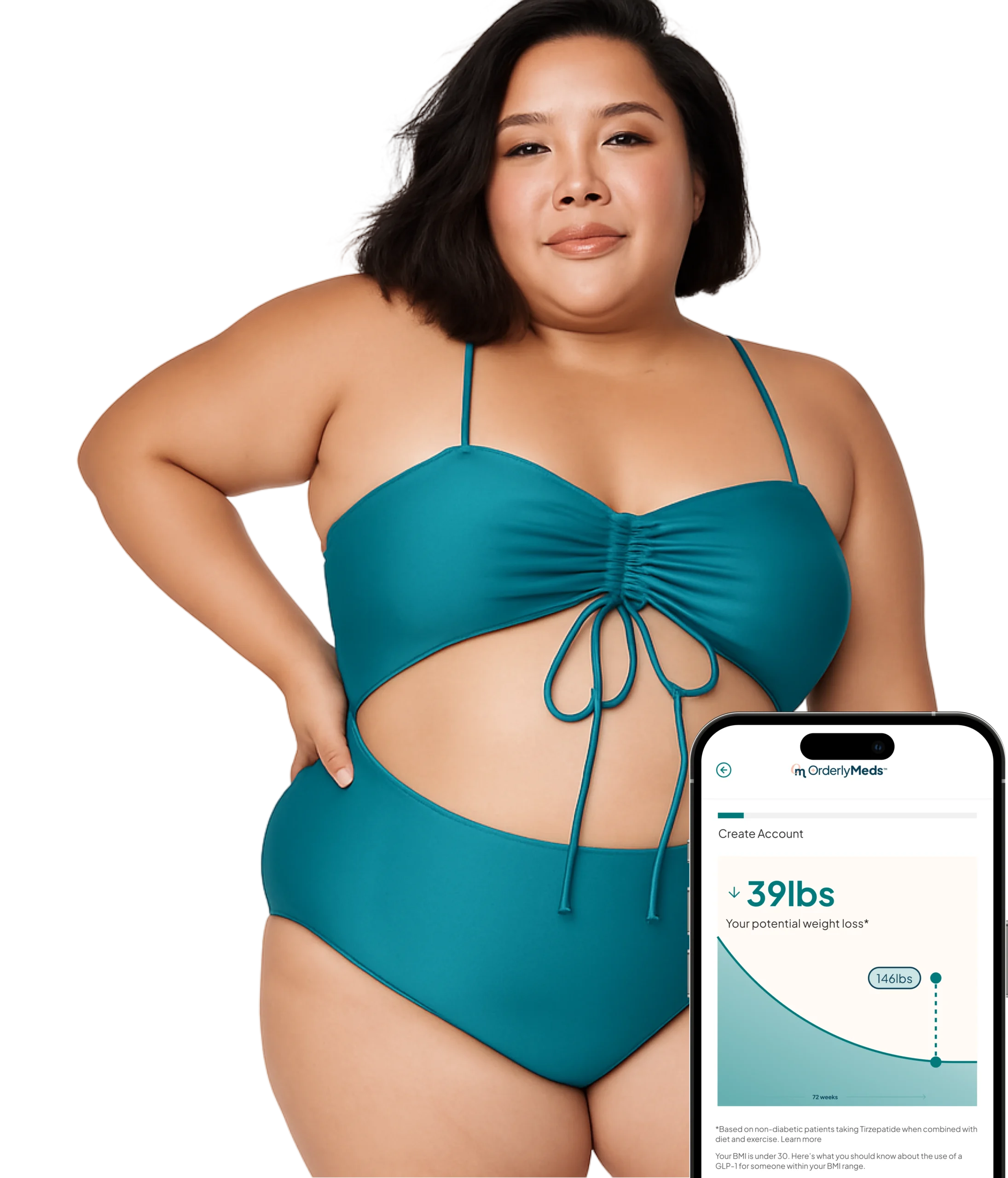
15lbs Average Loss in 3 Months | 4.7★ Google Rating

Sustainable Weight Loss with Expert Support:
Access compounded semaglutide or Tirzepatide through telehealth—significantly more affordable than branded alternatives. Join 100,000+ patients who’ve collectively lost over 2 million pounds with ongoing medical guidance and personalized dosing.
Your Complete Care Package Includes:
✓ $224 for 3-month starter plan (compounded semaglutide)
✓ Unlimited provider access with personalized dosing adjustments
✓ $3,700 value in nutrition resources, expert webinars, and community support
✓ Direct-to-home delivery with optional mental health partnership
Real medical care. Real results. Real support every step of your journey.
Best GLP-1 Options for Menopause Weight Loss
1. Semaglutide (Wegovy, Ozempic)
Semaglutide is a GLP-1 receptor agonist that has been available on the market for several years and has extensive research supporting its effectiveness. It works by activating GLP-1 receptors to reduce appetite and improve insulin sensitivity.
Wegovy (semaglutide 2.4 mg) is FDA-approved for chronic weight management in adults with obesity or overweight with at least one weight-related condition. While not specifically approved for menopause-related weight loss, it is commonly prescribed off-label for this purpose as menopause-related weight gain falls under chronic weight management.
Clinical trials show that semaglutide helps people lose an average of 14–15% of their body weight over 68 weeks. For someone weighing 200 pounds, that translates to approximately 28–30 pounds of weight loss. Semaglutide also offers cardiovascular benefits, reducing the risk of major cardiovascular events in people at high risk.
Common side effects include nausea, vomiting, diarrhea, and constipation. The medication is administered as a once-weekly injection, starting at a low dose that gradually increases over several months to minimize side effects.
2. Tirzepatide (Mounjaro, Zepbound)
Tirzepatide is a dual GIP/GLP-1 receptor agonist, meaning it activates two distinct hormone pathways rather than one. This dual action appears to enhance weight loss results beyond what GLP-1 activation alone achieves.
Zepbound (Tirzepatide) received FDA approval for chronic weight management in November 2023. Like semaglutide, it is not specifically approved for menopause but is used for weight management in menopausal women as part of comprehensive obesity treatment.
Clinical trials show that Tirzepatide produces greater weight loss than semaglutide. The dual-action mechanism targets both appetite regulation and metabolic function, which may be particularly helpful for the complex metabolic changes that occur during menopause.
Like semaglutide, Tirzepatide is given as a once-weekly injection with gradual dose increases to help your body adjust and minimize side effects, which are similar to those of semaglutide.
3. Liraglutide (Saxenda)
Liraglutide is an earlier GLP-1 receptor agonist, one of the first in this class approved for weight management. While it works through the same mechanism as semaglutide (activating GLP-1 receptors to reduce appetite), it has been largely overshadowed by newer options with more convenient dosing and stronger results.
Saxenda (liraglutide 3.0 mg) received FDA approval for chronic weight management in 2014. Like other GLP-1 medications, it is not specifically approved for menopause-related weight loss but may be prescribed for weight management during this transition.
Clinical effectiveness is more modest than that of newer GLP-1 medications. Research shows that liraglutide helps people lose an average of 5% of their body weight over 56 weeks, roughly half the weight loss seen with semaglutide or Tirzepatide. For someone weighing 200 pounds, this translates to approximately 10–16 pounds of weight loss.
A significant drawback is the daily injection requirement, compared to the once-weekly dosing of semaglutide and Tirzepatide. This makes it less convenient for long-term adherence. Side effects are similar to those of other GLP-1 medications, including nausea, diarrhea, and constipation, though these typically decrease over time.
While liraglutide remains an FDA-approved option, most healthcare providers now prefer prescribing semaglutide or Tirzepatide due to their superior weight-loss results and more convenient weekly dosing schedules.
Which GLP-1 Is More Effective for Menopause?
Based on current evidence, Tirzepatide appears more effective for weight loss than semaglutide. Its dual-action mechanism may be especially helpful for menopausal women facing multiple metabolic challenges.
However, “most effective” doesn’t automatically mean “best for you.” Several factors influence which medication makes the most sense for your situation.
- Semaglutide may be the better choice if you prefer starting with a medication that has been available and studied longer, if cost considerations are a factor, or if your provider recommends it based on your medical history.
- Tirzepatide may be the better choice if you need significant weight-loss support, haven’t achieved adequate results with semaglutide, or want the potential for enhanced results from its dual-action mechanism.
- Liraglutide may be considered if you have specific medical reasons that make the newer medications unsuitable, if your insurance only covers this option, or if you’re looking for a lower-cost GLP-1 alternative. But you should expect more modest weight loss results and daily injections rather than weekly dosing.
Your provider considers your medical history, current medications, weight loss goals, tolerance to side effects, and individual response when recommending one medication over the other. Some people may start with one medication and switch to another if results or side effects warrant a change.
What to Expect: Results & Timeline
GLP-1 medications work gradually, not overnight. Most people begin noticing appetite changes within the first few weeks of starting treatment, though these effects are often subtle at starting doses as your body adjusts to the medication.
Weight loss typically becomes more consistent as your dose increases over the first few months. Full effects usually establish once you’ve reached a maintenance dose that works for your body, which can take several months. For menopausal women, expect reductions not only in overall weight but also in waist circumference and visceral fat.
It’s important to set realistic expectations. While some people achieve dramatic results, sustainable weight loss is typically gradual. The goal isn’t perfection; it’s meaningful progress that protects your health and helps you feel better in your body. Your provider can help you understand what reasonable progress looks like for your individual situation.
Best GLP-1 for Menopause Weight Loss: Summary Table
| Feature | Semaglutide | Tirzepatide | Liraglutide |
| Brand Names | Wegovy, Ozempic | Mounjaro, Zepbound | Saxenda |
| Mechanism of Action | GLP-1 receptor agonist | Dual GIP/GLP-1 receptor agonist | GLP-1 receptor agonist |
| How It Works | Activates GLP-1 receptors to reduce appetite and improve insulin sensitivity | Activates both GIP and GLP-1 receptors for enhanced appetite regulation and metabolic function | Activates GLP-1 receptors similarly to semaglutide, but with an older formulation |
| Average Weight Loss | 14–15% of body weight over 68 weeks | 15–22% of body weight; greater weight loss than semaglutide due to dual-action mechanism | 5–8% of body weight over 56 weeks (roughly half that of semaglutide) |
| Dosing Schedule | Once-weekly injection | Once-weekly injection | Daily injection |
| Time on Market | Available longer with more extensive research | Newer medication with promising results | First GLP-1 approved for weight loss (2014); now largely superseded by newer options |
| Best For | Women seeking proven, well-studied weight loss support, those with cardiovascular risk factors | Women needing significant weight loss support, those who haven’t achieved adequate results with semaglutide | Women with insurance or cost constraints, those unable to use newer GLP-1 medications |
| Key Benefit | Established cardiovascular benefits and long-term safety data | Enhanced weight loss potential from dual-hormone activation | Longest safety track record; may be more affordable or covered by certain insurance plans |
| Side Effects | Nausea, diarrhea (typically transient and mild-to-moderate) | Similar gastrointestinal effects; typically transient and mild-to-moderate | Similar GI side effects; may be less tolerable due to daily dosing |
| Effectiveness During Menopause | Reduces visceral fat, improves insulin sensitivity, and counteracts menopausal metabolic changes | Particularly effective for multiple menopausal metabolic challenges due to dual-action | Modest impact on menopausal weight gain; less effective than newer alternatives |
Get Personalized Menopause Support with OrderlyMeds
Managing weight during menopause requires support that aligns with the changes your body is going through. At OrderlyMeds, we deliver personalized GLP-1 care designed to help you move toward real, sustainable results, with options including compounded semaglutide and compounded Tirzepatide to meet different needs and goals.
Your care team closely tracks your progress and adjusts your plan as your body responds, starting with a comprehensive health screening and a provider review. Treatment aligns with your goals, medical background, and menopause-related metabolic shifts right away. Pricing stays simple and upfront, covering provider care, prescribed medication when appropriate, and ongoing support, with no insurance hassles.
Your prescription plan also includes a full suite of tools, including menopause-focused meal plans, expert education, fitness and mental health resources, and a supportive member community. With nationwide coverage, FDA-regulated partner pharmacies, and an easy-to-use app, everything you need stays organized and accessible in one place.
Check Your Eligibility with OrderlyMeds →
Frequently Asked Questions (FAQs)
Are GLP-1 medications as effective for menopausal women as for younger women?
Yes. Research analyzing GLP-1 effectiveness across reproductive stages confirms that these medications are equally effective in premenopausal, perimenopausal, and postmenopausal women.
The same degree of weight loss, waist circumference reduction, and metabolic improvements occur regardless of where you are in the menopause transition.
Can I combine GLP-1 medications with hormone replacement therapy?
Many women successfully use GLP-1 medications alongside hormone replacement therapy (HRT). Some evidence suggests the combination may be particularly effective, as HRT can help preserve muscle mass, improve sleep and energy levels, and support overall metabolic health.
Always discuss any combination of medications with your healthcare provider to ensure they’re appropriate for your individual situation.
Which medication is better: semaglutide or Tirzepatide?
Clinical evidence shows Tirzepatide typically produces greater weight loss than semaglutide due to its dual-action mechanism.
However, the “better” choice depends on your individual factors, including your medical history, tolerance to side effects, and weight-loss goals. Your provider at OrderlyMeds can help determine which medication aligns best with your needs.
How does OrderlyMeds specifically support menopausal women?
OrderlyMeds’ care team understands the unique challenges of menopause-related weight gain.
We provide personalized GLP-1 treatment with both semaglutide and Tirzepatide options, along with resources specifically helpful during this transition, including menopause-focused nutrition guidance, strength training resources to preserve muscle mass, and access to mental health support through BetterHelp.
Your provider adjusts your treatment plan based on how your body responds, ensuring you get the support you need throughout your menopause journey.
*Disclaimer: This article is for informational purposes only and does not constitute medical advice. OrderlyMeds provides compounded medications not reviewed by the FDA for safety, efficacy, or quality. Always consult a licensed healthcare provider before starting any medication. Individual results vary, and medication should be used alongside healthy lifestyle practices.